
History
Specification: Edexcel
Head of Department: Mr Rob Harris
Email: roh@gryphon.dorset.sch.uk
Why study History?
History is an exploration of the past in which the lessons and themes discovered can be applied to situations both today and the future as well. It is the narrative of epic struggles; of influencial individuals; of pressure from the masses. History is understanding the complex interactions that have created the world we have inherited. By examining this light from within the distant darkness, not only does our knowleldge of the past grow but so does the knowledge of ourselves. It may be an academic discipline, but it is a fascinating tale as well; a story worth learning.
What will I study?
Russia from Lenin to Yeltsin: A thematic look at the government; economy; social impact and cultural significance from the October Revolution to the collapse of the Soviet Union. The module charts the process by which the hope of a new society is relentlessly supressed, controlled and terrorised. A special section explores the reasons for its eventual disintegration.
The GDR: Echoing the themes of the Russian module, this is an examination of the life of East Germany during the Cold War period. Students will cover the detail of how the state was created, before studying how its totalitarian nature dictated every aspect of life in an artifical country which needed to build a wall to keep its own citizens in.
America 1918-1970: An individual piece of coursework in which the student investigates a topic on America, by analysing three historians’ views on it. With topics ranging from Prohibition to McCarthyism; or the New Deal to Civil Rights, there is a real opportunity to focus on your own particular interests. It is a study in which the very nature of history is evaluated.
Britain’s Experience of War 1790-1918: A topic which looks both thematically and in special depth studies at the impact of war on the military and British society from the Napoleonic Wars to the great upheavals of the First World War. It enlightens the student on how periods of severe crisis can produce technological advancements and social progress.
How will I be assessed?
Three written papers are taken at the end of Year 13.
Paper 1 : Russia – worth 30%
Paper 2 : GDR – worth 20%
Paper 3 : Britain’s Experience of War – worth 30%
The coursework on America, completed in Year13, is worth 20% and is written independently by the student under their own circumstances.
Future Opportunities & Careers
The study of history can lead directly to careers in many professional fields such as law, academia, politics, business, or journalism. More importantly the skills developed, such as analysis, evaluation and the ability to comprehend and manipulate complex information, help create confident independent learners able to adapt to any career options, or even invent their own.
Entry requirements
Level 5 at GCSE History
Course Overview:
Year 12
- Half Term 1: Russia 1917-91; GDR 1945-91
- Half Term 2: Russia 1917-91; GDR 1945-91
- Half Term 3: Russia 1917-91; GDR 1945-91
- Half Term 4: Russia 1917-91; GDR 1945-91
- Half Term 5: USA Coursework; Losing and Gaining an Empire Breadth Study 1
- Half Term 6: USA Coursework; Losing and Gaining an Empire Breadth Study 1
Year 13
- Half Term 1: USA Coursework; Losing and Gaining an Empire Breadth Study 2
- Half Term 2: USA Coursework; Losing and Gaining an Empire Depth studies
- Half Term 3: USA Coursework; Losing and Gaining an Empire Breadth Depth Studies
- Half Term 4: Losing and Gaining an Empire Breadth Depth Studies
- Half Term 5: Revision
Assessment
In year 12 Students should expect 12 assessed pieces of work from each teacher/module. This includes the PPE in the Summer Term. These will all be in the form of exam questions.
In Year 13 The Coursework dominates half the year so there will be less assessed pieces of work, but they should expect 8 assessed works in the other Empire module. There will also be 2 PPEs within the year
Homework
Students should expect a homework every week. This will take a wide variety of forms. However the planning; drafting and writing of exam questions will dominate the types. Other homeworks could include revision tasks; reading; watching documentaries; researching. This will be set on Teams/assignment and is a vital part of preparing each student to perform to their maximum potential in the A Level. Every task is designed to add to the knowledge and skills facilitated in the lessons.
Useful information, links and resources
Please see our extensive reading lists which include specific reading; wider reading; things to watch and places to visit.
There is no need for textbooks as our content booklets cover the spec of the courses. However wider reading, as in the reading list, is expected from all students.
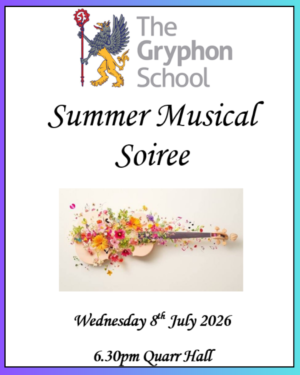
Summer Musical Soirée
6th July
Join us for The Gryphon School Summer Musical Soirée on Wednesday 8th July at 6.30pm in the Quarr Hall. Our talented students will be showcasing an evening of fantastic live music, singing...

Gryphon Alumni Success
7th July
We are delighted to celebrate the success of two former Gryphon School students who are achieving exciting milestones in their chosen careers. Ruby White Selected for Team England Commonwealth Games Squad Former...
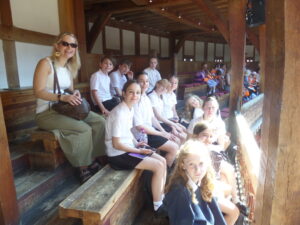
Poetry by Heart
10th July
Some of our Year 7 and 8 students visited the Globe Theatre, London on Monday. A group of finalists from our Poetry by Heart competition were lucky enough to travel to London...