
Maths
Key Stage 3 Subject overview
Key Contact James Parker jgp@gryphon.dorset.sch.uk
Anthony Shaw Anthony.Shaw@gryphon.dorset.sch.uk
We encourage a curiosity in our pupils, insisting that they can not only solve problems but also ask why and how it works.
Breaking the curriculum into small, manageable steps helps students to understand concepts better. Students study maths in distinct but interweaving blocks and each block of content in the scheme of work is broken into small steps that build on prior knowledge in a coherent way.
Mastery of maths demands a deep understanding of a reduced number of topics and students are challenged to think mathematically through well-planned questioning and intelligent, individual practise.
Course Content
Year 7
- Half Term 1: Algebraic thinking through: Sequences, Algebraic Notation and Equations
- Half Term 2: Place value and our number system and equivalence of Fractions, Decimals and Percentages
- Half Term 3: Applications of number: Solving problems with a deep understanding of arithmetic
- Half term 4: Working with types of numbers including negatives and fractions
- Half Term 5: Lines and angles: Geometric reasoning with angle facts and clear understanding of the notation
- Half term 6: Reasoning with number including Sets, types of numbers, Primes and Proof
Year 8
- Half Term 1: Proportional Reasoning through Ratio and scale and multiplicative reasoning
- Half Term 2: Representations of mathematical ideas Graphs in various contexts
- Half Term 3: Algebraic techniques: Brackets in algebra, equations and inequalities, sequences and indices
- Half term 4: Developing Number: Fractions, Percentages, Standard form
- Half Term 5: Developing Geometry: Areas of circles, Symmetry and Reflections
- Half term 6: Reasoning with Data: The data handling cycle and Averages.
Year 9
- Half Term 1: Reasoning with Algebra: Line graphs, Solving Equations and Testing Conjectures
- Half Term 2: Constructions in 2 and 3 dimensions: 3D shapes and Constructions and Congruency
- Half Term 3: Reasoning with Number: Using Percentages and Maths and Money
- Half term 4: Reasoning with Geometry: Pythagoras Theorem, Rotations and Translations
- Half Term 5: Reasoning with Proportion: Enlargement and Similarity, Solving Ratio and Proportion Problems.
- Half term 6: The Beginnings of GCSE: Trigonometry
Assessment
Assessments are in 2 forms. A series of small assessments that are used continuously to assess each block of learning and provide information so teachers can plan and reteach where needed along with larger, termly assessments that are cumulative and revise key numeracy skills.
Year 7
- Assessment 1: Cumulative Assessment 1
- Assessment 2: 1 hour Autum Term Assessment
- Assessment 3: Cumulative Assessment 2
- Assessment 4: 1 hour Spring Term Assessment
- Assessment 5: Cumulative Assessment 3
- Assessment 6: 1 hour Summer Term Assessment
Year 8:
- Assessment 1: Cumulative Assessment 1
- Assessment 2: 1 hour Autum Term Assessment
- Assessment 3: Cumulative Assessment 2
- Assessment 4: 1 hour Spring Term Assessment
- Assessment 5: Cumulative Assessment 3
- Assessment 6: 1 hour Summer Term Assessment
Year 9
- Assessment 1: Cumulative Assessment 1
- Assessment 2: 1 hour Autum Term Assessment
- Assessment 3: Cumulative Assessment 2
- Assessment 4: 1 hour Spring Term Assessment
- Assessment 5: GCSE Baseline Assessment
- Assessment 6: GCSE Retrieval Test in preparation for Year 10
Homework
All students have 1 hour of Sparx homework each week. They should aim to get 100% correct, using all the support both the maths department and Sparx offer. Sparx is designed to intelli8gently retrieve prior knowledge, testing and setting tasks that are suitable to each, individual student.
Useful information, links and resources
www.whiteroseeducation.com
www.SparxMaths.uk
www.Drfrost.org
Key Stage 4 Subject overview
Key Contact: Vincent Lynch Vincent.Lynch@gryphon.dorset.sch.uk
Anthony Shaw Anthony.Shaw@gryphon.dorset.sch.uk
Syllabus Information
Our curriculum in GCSE is working towards the Pearson Edexcel GCSE in Maths and is based on the Ebbinghaus Forgetting Curve. The GCSE is taught in a way that makes students revisit topics several times over the two years.
As with KS3, learning is broken into small steps and teachers will meet students where they currently are, assessing and teaching pre-requisites before tackling new maths. All classes follow the same curriculum as prior attainment is not always a determining factor of how well a class or individual student will cope learning a particular topic. Regular retrieval starters add reviews to the forgetting curve to enhance retention further.
Course Content
Each half term in Year 10 and 11 covers several topics that are repeated throughout the course. Each time students see a topic, it is taken deeper so that we introuduce, develop and, finally, find coherence between the big ideas in mathematics. As well as the topics set out below, teachers will work in extra revision and reteaching after each assessment to fill gaps in knowledge and exam skills.
Year 10
- Half Term 1: Angles, Expressions, Probability and Equations
- Half Term 2: Trigonometry, Fractions, decimals and percentages (FDP), Pythagoras and Constructions
- Half Term 3: Transformations, Calculations, Estimation,
- Half Term 4: Statistics, Graphs, Areas and Perimeters
- Half Term 5: Ratio and Proportion, Angles, Similarity and Congruence
- Half Term 6: Simultaneous Equations, Functions and Formulae, FDP, Trigonometry
Year 11
- Half Term 1: Graphs, Vectors, Expressions and Proof, Simultaneous Equations, Surds and Indices
- Half Term 2: Statistics, Functions, Ratio and Proportion (And Revision for Mock Exams)
- Half Term 3: Similarity and Congruence, Transformations, Probability, Expressions and Proof
- Half Term 4: Bespoke Learning for all classes
- Half Term 5: Revision and Exam preparations
Assessment
Assessments in Year 10 consist of 3 types. Retrieval tests can be on anything that should have been mastered in KS3; half term tests assess what has been seen in that half term and PPE covers everything to that point. Teachers use these assessments to identify areas to consolidate, practice and reteach, using flexible time built into our long-term plans.
Year 10
- Assessment 1: Retrieval 1
- Assessment 2: Half-Term Test 1
- Assessment 3: Retrieval
- Assessment 4: Half-Term Test 2
- Assessment 5: Retrieval
- Assessment 6: Half-Term Test 3
- Assessment 7: PPE Non-Calculator
- Assessment 8: PPE Calculator
- Assessment 9: Retrieval
- Assessment 10: Half-Term Test 5
- Assessment 11: Half-Term Test 6
- Assessment 12: Retrieval
Year 11
During Year 11, all assessments are past papers. Some are completed in lessons while others are formally completed in exam halls.
- Assessment 1: Non-Calculator GCSE Paper
- Assessment 2: Final Half-Term Test
- Assessment 3: Calculator GCSE Paper
- Assessment 4: PPE Non-Calculator GCSE Paper
- Assessment 5: PPE Calculator GCSE Paper
- Assessment 6: Calculator GCSE Paper
- Assessment 7: Non-Calculator GCSE Paper
- Assessment 8: Non- Calculator GCSE Paper
- Assessment 9: Calculator GCSE Paper
- Assessment 10: Calculator GCSE Paper
Homework
As in KS3, All students have 1 hour of Sparx homework each week. They should aim to get 100% correct, using all the support both the maths department and Sparx offer. Sparx is designed to intelli8gently retrieve prior knowledge, testing and setting tasks that are suitable to each, individual student.
Useful information, links and resources
www.SparxMaths.uk
www.Drfrost.org
www.OnMaths.com
https://qualifications.pearson.com/en/qualifications/edexcel-gcses/mathematics-2015.html

Gryphon Arts Week
13th July
Last week was Gryphon Arts week with 3 wonderful events celebrating the creative arts. Our Summer soirée saw a range of outstanding musical performances from a wide range of students. At Dance...

Summer Newsletter Out Now!
16th July
Our latest newsletter is out now, with all the highlights from the summer term!
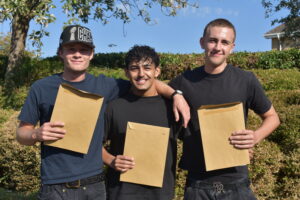
Gryphon Sixth Formers Celebrate Brilliant Results
13th August
The Gryphon Sixth Form is proud to announce another year of exceptional A-Level results, reflecting the ambition, dedication, and hard work of both students and staff. An impressive 30 students achieved three...