
Photography
Key Contact: Nigel White nw@gryphon.dorset.sch.uk
Photography at The Gryphon encourages creativity and independent learning. We encourage our students to take risks and find their creative talents. Handing responsibility and ownership of their learning to them and encouraging students to learn by exploration and experimentation. Looking at the work of other established photographers we encourage our students to take inspiration from them and develop their own styles of aesthetic and critical understanding. Looking at the everyday different is what makes a great photographer, and we actively develop this ethos within our students in order that they can let their creativity flow. Photography presents many opportunities for development in other areas such as games design, art, fashion, architecture and the like.
Course Content
Year 7
At present photography is not taught in year 7
Year 8
At present photography is not taught in year 8
Year 9
Groups in year 9 rotate with Hospitality & Catering on a triannual basis so the course content detailed below is repeated with each new group / rotation:
During the (approximately) 14-week unit students look at the fundamental skills of photography. Initially students look at compositional skills such as the law of thirds, use of shape, tone, texture, colour, the golden spiral, foreground dominance and leading line. After this has been completed student create their own series of images on a rolling theme. Emphasis is on the creation of images with a small theoretical element. Encouraging levels on independent learning and preparing students for photography GCSE.
Assessment
Year 9
Work is online and assessed via Microsoft Teams. Assessment comes from Research tasks, written evaluative comments and practical outcomes.
KS3 Progression
In Year 9, students begin by developing an understanding of how photographs can be used to communicate ideas, emotions and stories. Through a practical project, including macro and small-world photography, students learn the fundamentals of camera use, composition, lighting and image editing. They are encouraged to experiment with different viewpoints, techniques and creative approaches.
Alongside practical work, students are introduced to the work of a photographer, learning how to analyse images and discuss the choices made by photographers.
KS3 End point
By the end of Year 9, students will be able to use a camera with increasing confidence and demonstrate an understanding of basic photographic techniques, including composition, lighting and image editing. Students will be able to analyse and discuss the work of photographers using appropriate subject vocabulary They will have experience of planning, experimenting and evaluating their work.
Homework
Students are log onto the MS Teams PowerPoint and complete and written elements outstanding this is set once per term at the end of the unit.
Useful information, links and resources
17 of the “best” photographer websites: The 17 best photography websites | Creative Bloq
How to analyse a photograph: Image Analysis – Photography (weebly.com)
Key Stage 4 Subject overview
Key Contact: Nigel White nw@gryphon.dorset.sch.uk
Syllabus Information:
Students study the Eduqas photography syllabus comprising of 2 core components. Component 1 is coursework based and makes up 60% of the GCSE grade. Component 2 is an exam question which runs from January until April of year 11 and makes up the remaining 40% of the grade.
At the start of year 10 students are introduced to core camera skills and techniques at both a practical and theoretical level. Mini workshops lead to students developing their own styles and standard ways of working. Students are encouraged to develop their own styles and skills and are exposed to many of the different avenues that photography can lead them. This leads to larger (termly) projects. After Easter of year 10, students start on the component 1 element, and work on this until Christmas of year 11. In January of year 11 the exam paper is launched and completed in the penultimate weeks before Easter.
Course Content
Year 10
- Half Term 1: Skill Building Theme: Capturing Miniature Worlds
- Half Term 2: Shoot the thing you love
- Half Term 3: Mixed Media
- Half Term 4: Theme TBC choice of : Fashion/Transport (toys>vehicles)/The Environment (nature)
- Half Term 5: Reality vs Illusion
- Half Term 6: Unit 1 introduction
Year 11
- Half Term 1: Unit 1 statement of intent leading to development
- Half Term 2: Unit 1 development
- Half Term 3: Unit 1 final images and mock exam
- Half Term 4: Unit 2 / Exam
- Half Term 5: Unit 2 / Exam
Assessment
Year 10
- Assessment 1: Cyanotype (practical and theory)
- Assessment 2: Pinhole camera (practical and theory)
- Assessment 3: Macro workshop
- Assessment 4: Shoot the thing you love (written element)
- Assessment 5: Shoot the thing you love (practical element)
- Assessment 6: Mixed media 1 (Digital)
- Assessment 7: Mixed media 2 (Practical)
- Assessment 8: Objects (Studio Workshop)
- Assessment 9: Objects (Natural light workshop)
- Assessment 10: Unit 1 – Critical Study 1 (written)
- Assessment 11: Unit 1 – Critical Study 1 (practical)
- Assessment 12: Unit 1 – Critical Study 2 (Written)
Year 11
- Assessment 1: Unit 1 – Critical Study 2 (practical outcome)
- Assessment 2: Unit 1 – Creative statement part 1
- Assessment 3: Unit 1 – Shoot planning (both studies)
- Assessment 4: Unit 1 – Experimental shoot 1 (practical outcome)
- Assessment 5: Unit 1 – Creative Statement part 2
- Assessment 6: Unit 1 – Experimental shoot 2 (practical outcome)
- Assessment 7: Unit 1 – Shoot plan, shoot and evaluation (ES2 written element)
- Assessment 8: Unit 1 – Creative Statement part 3
- Assessment 9: Unit 1 – Final Outcomes (practical)
- Assessment 10: Unit 1 – Final outcomes (written evaluation)
Homework
Set on a rolling bases depending on what unit is currently being studied. Expectation is that students will spend time outside of school creating images or finalising written elements. The equates to approximately one hour of homework per week.
KS4 Progression
At Key Stage 4, students build upon the foundations established in Year 9 and develop a deeper understanding of photography as both an art form and a means of visual communication. Following the Eduqas GCSE Photography specification, students learn to investigate the work of photographers and artists, explore creative ideas, and develop personal responses through sustained practical enquiry.
Throughout Years 10 and 11, students refine their technical skills using cameras, digital editing software and a range of photographic processes. They learn how to plan and carry out purposeful photoshoots, analyse and evaluate their work, and make informed decisions about how to improve and develop outcomes. Students are introduced to studio photography, gaining experience of professional lighting equipment, backdrops and controlled shooting environments.
As students progress through the course, they become increasingly independent, learning to manage projects, meet the Eduqas Assessment Objectives and produce a portfolio that demonstrates creativity, technical skill and personal engagement.
KS4 End point
By the end of Key Stage 4, students will have developed the knowledge, skills and confidence required to successfully complete the Eduqas GCSE Photography course. They will be able to investigate photographers and artistic influences, generate and develop ideas, experiment with a range of photographic techniques and present personal outcomes that communicate clear intentions.
Students will demonstrate confidence in using cameras, studio equipment and digital editing software to produce technically competent and visually engaging images. They will understand how to analyse photographic work using appropriate subject terminology and make meaningful connections between the work of established photographers and their own projects.
Students will have experience of working independently, managing sustained projects and responding creatively to themes and briefs. They will understand the importance of research, experimentation, recording and refinement in the photographic process and will be well prepared for progression to A Level Photography, further creative study or related pathways within the creative industries.
Useful information, links and resources
More information on course content: GCSE Specification Template
How your work is assessed: eduqas-gcse-art-design-1.pdf
17 of the “best” photographer websites: The 17 best photography websites | Creative Bloq
How to analyse a photograph: Image Analysis – Photography (weebly.com)
Depth of field simulator: DOF simulator – Camera depth of field calculator with visual background blur and bokeh simulation.
(Article) – 50 great photographers of all time: The 50 best photographers ever | Digital Camera World

Gryphon Alumni Success
7th July
We are delighted to celebrate the success of two former Gryphon School students who are achieving exciting milestones in their chosen careers. Ruby White Selected for Team England Commonwealth Games Squad Former...
Poetry by Heart
10th July
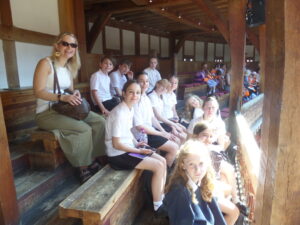
Some of our Year 7 and 8 students visited the Globe Theatre, London on Monday. A group of finalists from our Poetry by Heart competition were lucky enough to travel to London...

Year 11 and 13 Prom
13th July
It was wonderful to celebrate our Year 11 and 13 Leavers at their Proms this year. Both were superb events and a great time was had by all.