
Physics
Key Contact: Clark Davies cwd@gryphon.dorset.sch.uk
Syllabus Information: AQA A Level Physics A
Course Content
AQA’s A Level in Physics A specification aims to encourage learners to:
- develop essential knowledge and understanding of different areas of the subject and how they relate to each other
- develop and demonstrate a deep appreciation of the skills, knowledge and understanding of scientific method
- develop competence and confidence in a variety of practical, mathematical and problem solving skills
- develop their interest in and enthusiasm for the subject, including developing an interest in further study and careers associated with the subject
- understand how society makes decisions about scientific issues and how the sciences contribute to the success of the economy and society (as exemplified in ‘How Science Works’ (HSW)).
Year 12
- Half term 1: Statics, Motion and Particles.
- Half term 2: Momentum and Newton’s laws, Quantum and Waves.
- Half term 3: Work Done and energy, Electricity and Optics.
- Half term 4: Electricity and Materials.
- Half term 5: Gravitational fields, Electric fields and Thermal
- Half term 6: PPE revision, complete Gravitational fields and Circular motion.
Year 13
- Half term 1: Capacitors, Gases and Simple Harmonic Motion.
- Half term 2: Magnetic fields and Radioactivity.
- Half term 3: Induction and finish radioactivity.
- Half term 4: Astro and Nuclear energy.
- Half term 5: Revision and exam technique.
Assessment
Students will complete a minimum of 12 assessment tasks in Year 12 and 13. These will contain exam questions from past papers. These assessments will include:
Year 12
- Resolving forces and vectors
- Moments
- SUVAT
- Projectiles
- Newton’s laws
- Force and momentum
- Electric current
- Practical techniques
- DC circuits
- Gravitational fields
- Electric fields
- Photons and nuclei
- Particle interactions
- Particle sorting
- Quantum
- Waves
- Refraction and TIR
- Diffraction
- Density and Hooke’s law
- Materials
- Thermal
- Mixed questions
- PPE
Year 13
- Electric and gravitational fields
- Capacitors
- Practical assessment
- Magnetic fields
- Induction
- Astrophysics part 1
- Astrophysics part 2
- Gases
- SHM part 1
- SHM part 2
- Properties of radiation
- Radioactivity
- Energy and mass
- Mixed topics
- PPE
Homework
You will be given a homework booklet for each topic. Your teacher will set work from this each week.
You will also be set forms quizzes, research tasks, revision tasks as well as your own private study on particular areas of the course. We expect you to complete background reading on a lesson-by-lesson basis using the course texts and online resources. You should consolidate your notes using an appropriate method to suit your learning style (examples include: A6 consolidation cards, flow diagrams, bullet pointed sequenced lists, mind/concept maps) using the textbook and additional resources identified by your teacher. If you are struggling to consolidate your knowledge and understanding, then your teacher will help you with this skill.
KS5 Progression
As students progress into Key Stage 5, they build on their GCSE knowledge to develop a deeper and more sophisticated understanding of physics. They become increasingly confident in explaining complex ideas using advanced scientific terminology and clear reasoning.
Students strengthen their mathematical skills, learning to manipulate more complex equations and apply them to solve challenging problems. They are encouraged to make connections across different areas of the course and apply their knowledge to real-life situations, developing a more holistic understanding of physics.
Practical work continues to play a key role. Students develop a more independent and methodical approach to investigations, including planning experiments, using equipment with precision and evaluating both their methods and results with a critical eye.
Alongside this, students grow as scientists by developing key skills such as analytical thinking, problem solving, attention to detail, resilience, and the ability to evaluate evidence and form well-supported conclusions. They also build independence and confidence in their learning, preparing them for higher education and future careers in science and related fields.
KS5 End point
By the end of Year 13, students will demonstrate a deep and secure understanding of advanced physics concepts, using precise and sophisticated scientific terminology to explain complex processes and phenomena. They will confidently apply and manipulate a wide range of mathematical techniques to solve challenging and unfamiliar problems.
Students will be able to draw together knowledge from across the course, making connections between topics and applying their understanding to real-world contexts and scenarios.
They will show high levels of competence in practical and investigative work, working methodically to plan and carry out experiments, use equipment with accuracy and precision, and critically evaluate their methods, data and conclusions.
As developing scientists, students will demonstrate strong analytical thinking, problem-solving ability, resilience, attention to detail and independence. They will be able to evaluate evidence, construct well-reasoned arguments and communicate their ideas clearly.
This end point prepares students for successful progression to higher education and careers in physics, engineering and other science-related fields.
Useful information, links and resources
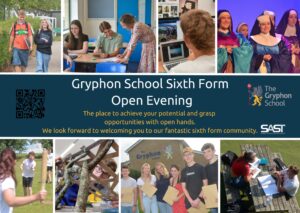
Gryphon Sixth Form Open Evening 2026
5th October
Thursday 22 October • 5:30 PM - 7:30 PM Explore the opportunities we have to offer that form part of the sixth form experience at The Gryphon School. We look forward to...

School Games Silver Mark Award
1st July
The Gryphon School is delighted to announce that it has been awarded the School Games Silver Mark Award, recognising the school's outstanding commitment to providing high-quality physical education, competitive sport and inclusive...
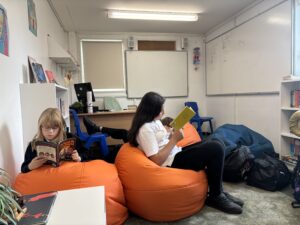
Gryphon Book Nook Now Open!
6th October
We are very excited to share the news that we have opened a new space in the school - The Book Nook. This is a calm, cosy space dedicated to reading and...